


Many users today seek a clear explanation of how claims process automation works in the insurance sector. This article is designed to answer this question to a wide audience, including insurance company managers, staff, business owners, and digital transformation specialists.
Traditionally, claims processing has faced various challenges such as high operational costs, long processing times, extensive manual data entry, and a high risk of human error. These issues have made it difficult for insurers to deliver satisfactory service.
The goal of this article is to fully explore the topic of automated claims processing: what it is, how it operates, why it is used, which technologies support automation, and what tools are available on the market. Readers will gain insight into the logic behind claims processing workflows, understand the benefits of automation, and learn how to select the right solutions for their needs.
Additionally, the article will highlight innovations related to artificial intelligence (AI) and provide real-world examples of claims automation in action, showing how advanced automation transforms the claims experience for insurers and policyholders alike.
What is Claims Processing and Why Automation is Needed
1.1 What is claims processing?
Claims processing is the complete cycle of actions that an insurance company undertakes from the moment it receives notification of an incident to the final payout or denial of the claim. It includes several stages: claim registration, data verification, damage assessment, decision-making, and settlement.
The process starts with the First Notice of Loss (FNOL), when the policyholder reports the incident. Next, the insurer verifies the details and coverage, assesses the damage or loss, and makes a decision to approve or deny the claim. If approved, the payment is processed and issued to the policyholder or service providers.
Traditionally, claims processing involves a lot of manual work such as paperwork, data entry, and individual case reviews, which can result in lengthy processing times and a high risk of human error. These challenges have made automation in claims processing essential to reduce costs, speed up claim handling, and improve customer satisfaction.
1.2 What is automated claims processing?
Automated claims processing refers to the use of technology and software to perform routine and repetitive stages of the claims process without human intervention. This includes tasks such as data collection, validation, routing, and decision-making on straightforward cases.
Such systems can automatically verify documents and data, apply business rules, and even predict claim outcomes. Technologies like AI, machine learning, optical character recognition (OCR), and robotic process automation (RPA) are used to speed up these processes and reduce manual errors.
1.3 Why do insurance companies automate claims processing?
Key goals of automating claims processes include improving handling times and customer satisfaction, reducing errors, and lowering operational costs. Manual claims processes are often slow, error-prone, and resource-intensive due to volumes and complexity.
The rise of digital service channels has made automation essential to meet customer expectations for accurate and 24/7 accessible claims service. Importantly, automation does not replace human experts but frees them to focus on complex cases requiring expert judgment, while routine claims are efficiently handled by automated systems.
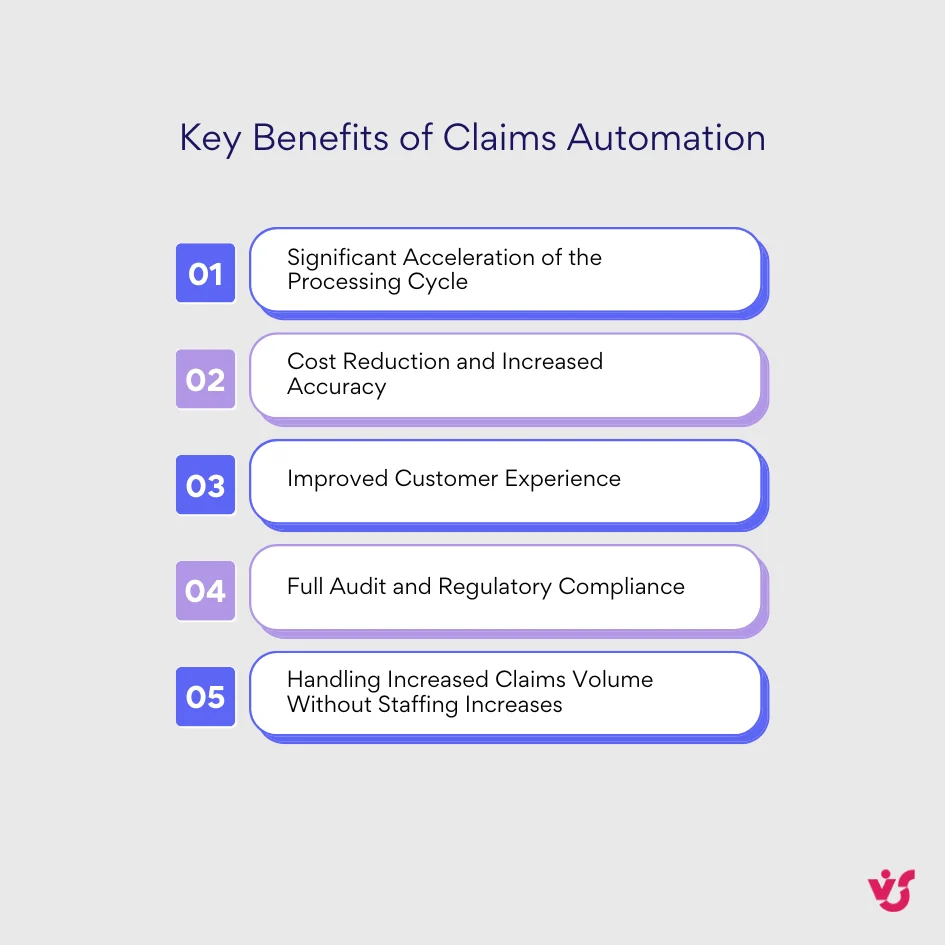
Key Benefits of Claims Automation
Automated claims processing offers crucial advantages that transform how insurance companies handle claims:
- Significant Acceleration of the Processing Cycle: Claims processing automation can reduce claim resolution times from days to just minutes, especially for straightforward cases.
- Cost Reduction and Increased Accuracy: Automation minimizes manual data entry, which drastically reduces errors and lowers costs.
- Improved Customer Experience: Fast and transparent claims processing is a key driver of customer loyalty. Automated systems enable real-time updates and quick decisions.
- Full Audit and Regulatory Compliance: Automated claims systems log every action, providing full transparency and easier compliance with regulatory requirements.
- Handling Increased Claims Volume Without Staffing Increases: Claims automation allows insurers to process significantly more claims with the same number of employees by eliminating manual routine and accelerating key steps in the process.
How Automated Claims Processing Works
3.1 Automated Claims Processing: Components and Principles
Automated claims processing relies on several components that work together to speed up the insurance claim lifecycle:
- Intelligent Data Capture: AI-powered tools such as Optical Character Recognition (OCR) and Natural Language Processing (NLP) extract information from various claim documents, forms, images, and reports automatically, reducing manual data entry errors.
- Automated Validation and Verification: The system cross-checks collected data against policy details, coverage limits, and historical claims, applying business rules and fraud detection algorithms for accuracy.
- Claims Calculation and Decisioning: Automated engines calculate payout amounts based on predefined rules and machine learning models that assess risk and predict outcomes.
- Client Notifications: Automated alerts and communications keep clients informed in real-time about claim status updates, improving satisfaction.
The algorithm replaces many manual actions by automating data collection, validation, routing, and decisions, significantly accelerating the claims workflow. Automation can range from partial (supporting specific tasks) to full end-to-end claims processing.
3.2 How to Automate Claims Processing?
Typical approaches to claims automation include:
- Workflow Systems Integration: Using specialized claims management workflow platforms to orchestrate automated tasks.
- CRM Integration: Linking automation with customer relationship management (CRM) systems for data sharing.
- AI Modules: Implementing AI for intelligent document processing, fraud detection, and decision support.
- Rule-based Automated Checks: Applying predefined rules to automate eligibility verification and approvals.
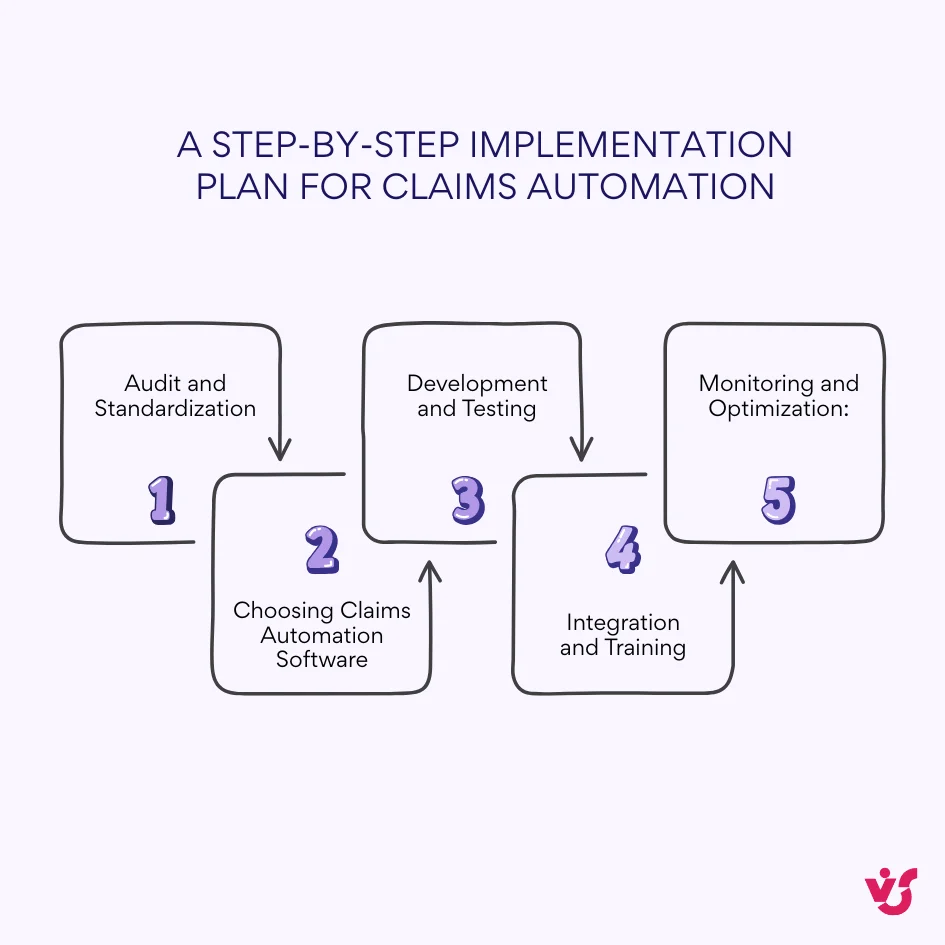
A step-by-step implementation plan for claims automation involves:
- Step 1: Audit and Standardization: Identify the most repetitive tasks and high-risk error points; standardize processes before automation.
- Step 2: Choosing Claims Automation Software: Select a tool that best fits organizational needs and integrates well with existing systems.
- Step 3: Development and Testing: Start automating a small but critical process (e.g., automatic claim registration) to test effectiveness and gain team support.
- Step 4: Integration and Training: Integrate new software with core systems (CRM, Core System) and train staff accordingly.
- Step 5: Monitoring and Optimization: Continuously track performance metrics (like processing time) and refine automation workflows for maximum impact.
Pitfalls during the implementation of automated claims processing
Common pitfalls during the implementation of automated claims processing can significantly undermine the potential benefits if not properly addressed early on:
❌ Inadequate Process Standardization: When insurance processes are not sufficiently standardized before automation, the system often inherits inconsistencies. This makes automation less effective and can cause errors to propagate through the workflow. Standardizing processes beforehand ensures clarity, uniformity, and simplifies automation development.
❌ Underestimating Integration Complexity: Insurance companies usually have multiple legacy systems (policy management, CRM, document repositories) that need to work seamlessly with new automation tools. Poor integration planning can lead to data silos, delays, and manual workarounds that negate automation benefits. A thorough integration strategy, including robust APIs and real-time synch is critical for success.
❌ Insufficient User Training and Change Management: Even the most advanced claims automation software requires users to understand and effectively interact with it. Without proper training, employees may resist change, make errors, or underutilize automation features. Continuous learning programs and clear communication help foster adoption and build confidence across teams.
❌ Additional Considerations:
- Avoid starting with overly complex claims or policies for automation proofs; begin with simple, low-risk cases to build trust.
- Engage cross-functional teams early, including digital claims, underwriting, IT, and compliance, to cover all angles and ensure regulatory adherence.
- Monitor automation closely post-deployment to identify issues like customer dissatisfaction or exceptions that require manual intervention.
Addressing these pitfalls proactively creates a smoother path for realizing the full advantages of claims processing automation, including faster claims cycles, cost savings, and top-level customer experiences.
Examples of Successful Automated Claims Processing
Automated claims processing has proven effective in various insurance domains. Here are typical scenarios showcasing its application:
- Automobile Claims Automation: From claim submission to damage assessment and final payout, automation streamlines all stages. Intelligent data capture extracts accident details and photos, automated rules verify coverage and calculate payouts, and communication systems keep claimants informed promptly.
- Medical Claims Processing: Automation verifies policy coverage and automatically calculates compensation based on submitted medical documents and billing codes. This reduces manual errors and speeds up approval for routine healthcare claims.
- Property Insurance Claims: Advanced systems use intelligent damage assessment supported by image recognition and manage repair workflows efficiently. Automation aids in validating claims, estimating repair costs, and coordinating with service providers.
- Small, High-Volume Claims: For minor claims, full automation from registration through payment enables insurers to handle large volumes swiftly without adding staff, greatly improving efficiency and customer experience.
Overview of Systems and Tools for Claims Automation
5.1 Claims Automation Software: Popular Systems and Selection Criteria
What are claims processing systems?
Claims processing systems are software platforms designed to automate and speed up the entire or part of the insurance claims lifecycle. They help reduce manual workload, improve accuracy, and accelerate claims resolution.
Types of Claims Processing Systems
- Specialized Claims Systems: These are dedicated platforms built specifically for claims management, serving as the backbone for all claims operations. Example: Guidewire ClaimCenter. Guidewire offers comprehensive features including automated workflows, fraud detection, and multi-line claims support, widely used by property and casualty insurers.
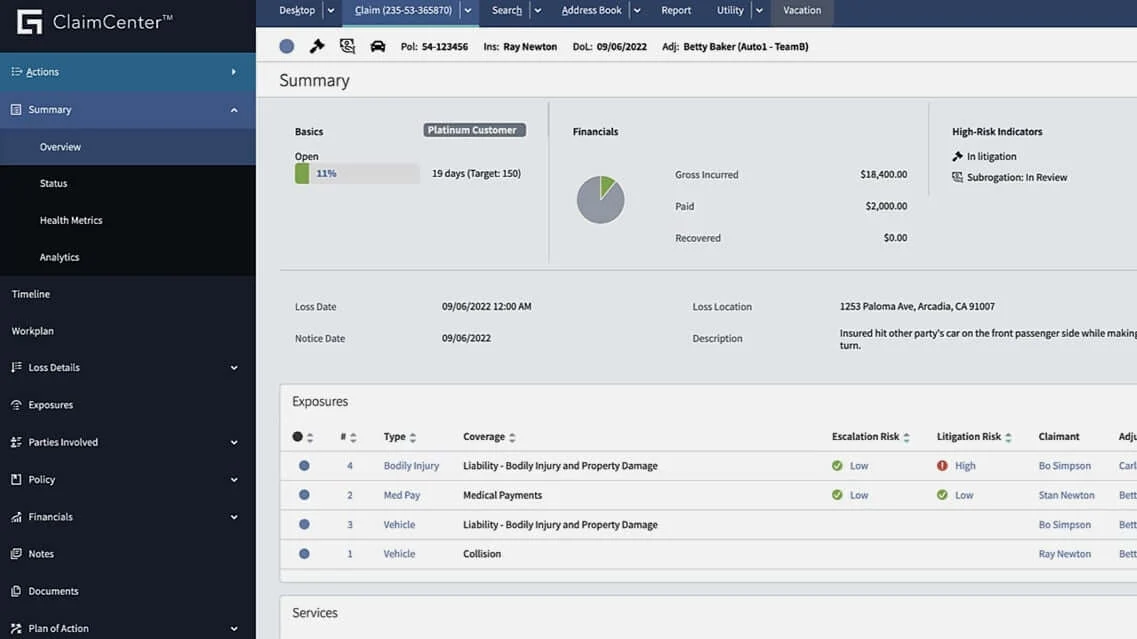
Source: Guidewire ClaimCenter
👉 Learn about Admin Calendar »>
- Universal BPM (Business Process Management) Systems: Flexible platforms designed to model, execute, and optimize claims-related processes with low-code/no-code configuration. Examples: Pega and Appian. These systems excel in adaptability to complex, evolving workflows, suitable for insurers with diverse and changing claims requirements.
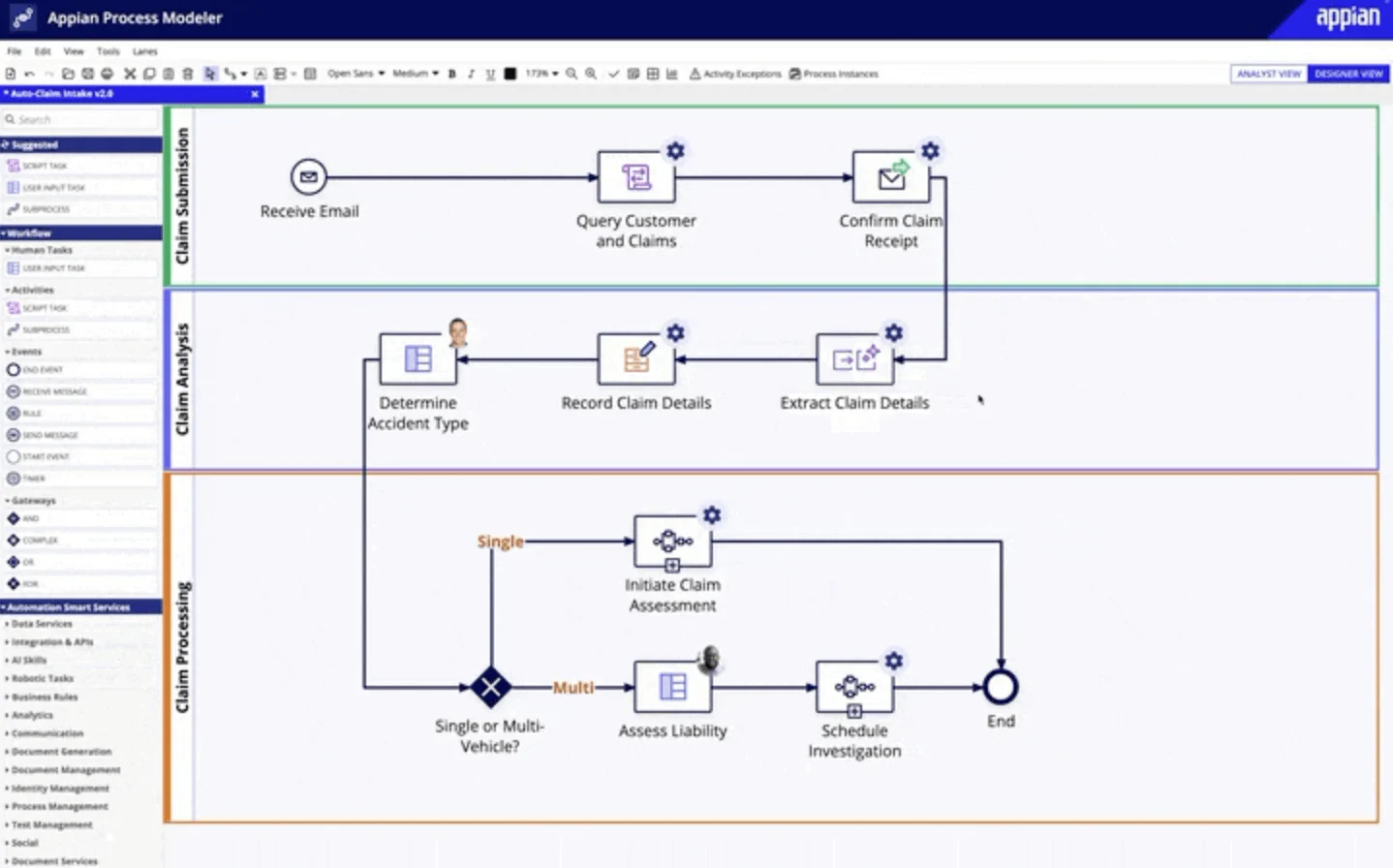
Source: Appian
- Office Infrastructure Automation Tools: General automation platforms integrated within existing office IT environments for task-specific automation. Example: Microsoft Power Automate. These tools are ideal for automating repetitive manual tasks such as data entry, document routing, and email notifications within claims processing.
👉 Learn more about SharePoint Automation »>
Criteria for Choosing Claims Automation Software
- Ease of Integration: Seamless connection with existing IT infrastructure like CRM, ERP, policy administration, email, and customer portals is critical for efficient data flow.
- Process Customization Without Coding: The ability to modify and optimize workflows using visual tools without heavy developer involvement speeds up deployment and responsiveness.
- Support for Automated Rules and AI: Incorporation of AI capabilities for intelligent data extraction, fraud detection, and decision-making enhances automation effectiveness.
- Scalability and Analytics: Solutions should support increased claim volumes and provide real-time analytics and reporting to monitor operational performance.
- Data Security: Robust security certifications and compliance with data protection regulations are mandatory to safeguard sensitive policyholder information.
5.2 Solutions for Automating Claims Processing in SharePoint
Using SharePoint as a platform for automated claims processing offers several advantages:
- Centralized Storage of All Claims Documents: SharePoint serves as a secure, centralized repository for all documents related to claims, making it easy to manage and retrieve files.
- Robust Security and Access Control: It provides reliable mechanisms for data security and fine-grained access control, ensuring sensitive information is protected and only accessible to authorized users.
- Integration with Office Applications for Collaboration: SharePoint seamlessly integrates with Microsoft Office applications, enabling real-time collaboration and document editing among teams.
- Familiar User Environment: Many users are already acquainted with SharePoint, reducing training time and improving user adoption.
While SharePoint lays the foundation with centralized storage, security, permissions, and basic workflows, transforming these capabilities into a flexible and fully managed claims automation system requires advanced process automation tools. Which one fits depends on where SharePoint runs:
Power Automate for SharePoint Online & Microsoft 365
In SharePoint Online, claims workflows are built in Microsoft Power Automate; Microsoft retired SharePoint 2013 workflows there on April 2, 2026. A flow starts when a claim is added to a SharePoint list or its documents land in a library, and it can:
- Route by rules: Conditions on claim amount, policy type, or complexity send each claim to the right specialist.
- Run approval chains: The Approvals connector handles sequential or parallel reviews by experts, underwriters, and legal teams, answered in Microsoft Teams or Outlook.
- Notify stakeholders: Email and Microsoft Teams messages report new claims, status changes, required actions, or delays.
- Keep documents in SharePoint: Claim files stay in SharePoint libraries, under the permissions and audit logs the tenant already has.
Premium connectors and the flow-run limits of each licence tier affect cost at claims volumes, so check them before scaling.
Virto Workflow Automation On-Premise
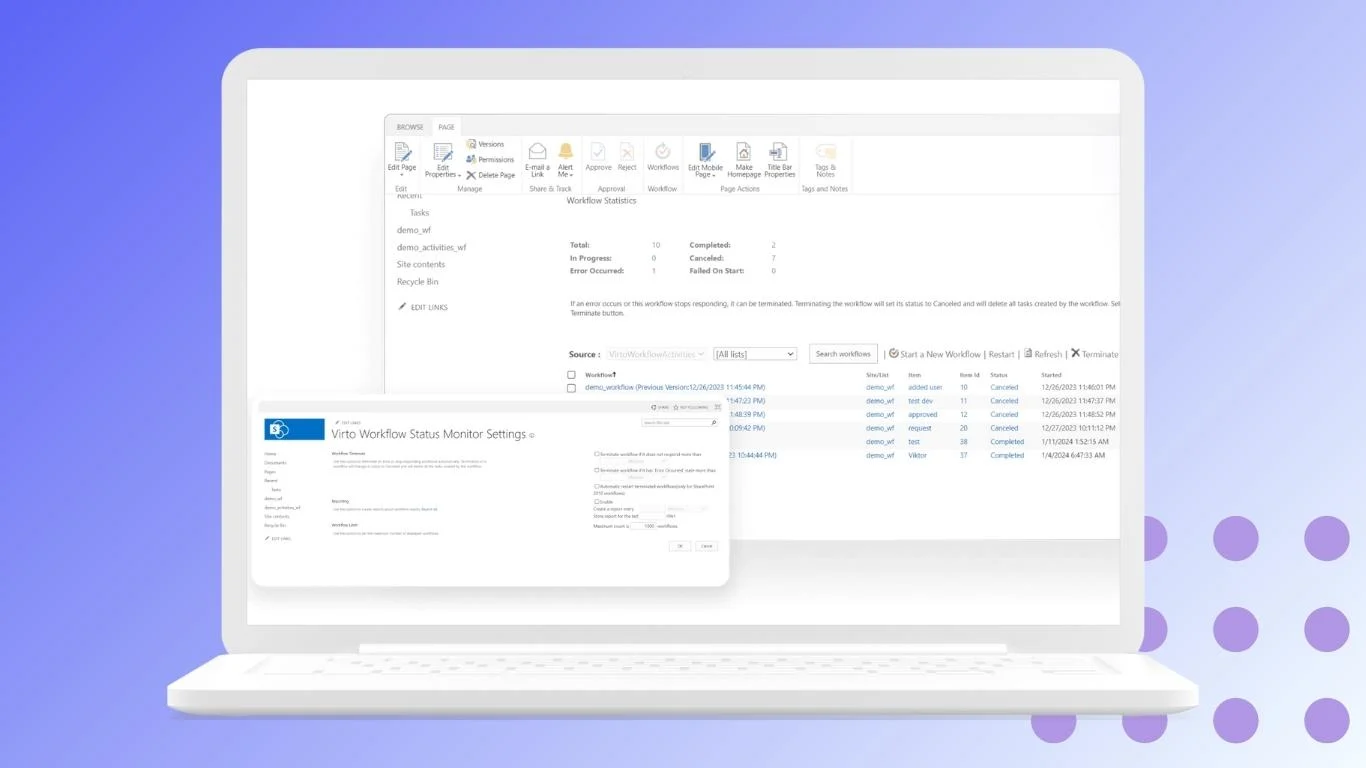
Virto Workflow Automation On-Premise is the updated solution for automating processes within SharePoint On-Premises. It includes Virto Workflow Activities Kit, Virto Workflow Status Monitor Web Part, and Virto Workflow Scheduler Web Part, combining advanced workflow building actions, scheduled automation, and convenient monitoring of process statuses.
Key advantages for insurance companies include:
- Operation Within Corporate Secure Environment: The solution is deployed within the organization’s infrastructure, offering a corporate, isolated, and fully controlled environment. This allows secure handling of sensitive data without transferring it to external clouds.
- Compliance with Strict Regulatory Requirements: Local data storage and access control facilitate adherence to industry standards, insurance regulations, and oversight requirements.
- Advanced Automation Actions for Claims Handling: The Activities Kit provides a wide range of ready-to-use workflow operations for data validation, calculations, approvals, escalations, status updates, and parallel task execution.
- Support for Complex Logic in Calculations and Data Verification: Internal computations, data completeness checks, cross-references with corporate directories, and rule executions within SharePoint workflows can be automated.
- Automation of Standard Claims Processing Procedures: Typical claims steps—application registration, initial validation, routing, assessment, and approval—can be formalized into controlled, repeatable processes.
- Workflow and Rule Configuration Without Coding: Business and functional users can configure process logic, transitions, and handling scenarios directly via SharePoint Designer, minimizing developer involvement.
- Flexible Claims Routing: Routes can be set based on policy type, claim amount, risk category, region, priority, and other parameters. Conditional branching, approval cycles, and parallel stages are supported.
- Process Execution Control and Transparency (Status Monitor Web Part): Enables tracking of all running workflows, viewing execution stages, delays, and bottlenecks—helpful for managers and operations teams.
- Automated Scheduled Workflow Launching (Workflow Scheduler Web Part): Workflows can be triggered automatically on daily, weekly, custom schedules, or specified intervals for routine checks, updates, or batch operations.
How Virto Solutions Support Claims Processing Automation
1. Flexible Workflow Customization
- Business analysts and functional users can visually design and modify complex claims handling workflows using SharePoint Designer together with Virto workflow activities.
- No coding skills are required, enabling rapid adaptation to changing insurance policies, regulations, and company requirements.
2. Intelligent Claims Routing
- Automation rules automatically direct claims to appropriate specialists based on criteria such as claim amount, policy type, risk category, and complexity.
- This speeds up claims assignment, reduces manual errors, and ensures faster case handling.
3. Automated Data Validation and Management
- Incoming claim data from forms, portals, or other systems is automatically validated for completeness and accuracy.
- Documents related to claims are organized, linked, and stored in SharePoint libraries, ensuring secure access and easy retrieval.
4. Streamlined Approvals and Compliance
- Configurable approval chains support sequential and parallel reviews involving underwriters, legal teams, and managers.
- Built-in audit trails capture key process events to support regulatory compliance and internal audits.
5. Automated Notifications and Communication
- Customizable email and SMS alerts keep stakeholders informed about new claims, status updates, pending approvals, and other critical events.
- Enhances transparency and responsiveness during claim resolution.
6. Integration and Security
- Virto Workflow Automation On-Premise operates within the insurer’s secure IT infrastructure, addressing strict data privacy and regulatory requirements.
- Advanced workflow actions support complex calculation logic, scheduled workflows, and real-time monitoring for better control over claims processes.
These capabilities collectively reduce manual workload, minimize errors, accelerate claim processing timeframes, and improve customer satisfaction by ensuring fast, transparent, and consistent claims handling within the SharePoint environment.
Modern Technologies, AI’s Role in Claims Automation, and Future Trends
6.1 Technologies in Claims Process Automation
Claims process automation employs multiple advanced technologies to transform traditional insurance workflows into efficient, digital-first operations:
- Artificial Intelligence (AI) and Machine Learning (ML): These technologies analyze complex data such as claimant submissions, damage photos, and medical reports. AI models can interpret unstructured text with natural language processing (NLP) and predict outcomes, while ML improves decision accuracy by learning from historical claims data.
- Robotic Process Automation (RPA): RPA software handles repetitive, rule-based tasks like data entry, document routing, and sending notification emails. This automation reduces manual workload and accelerates claim handling times.
- Optical Character Recognition (OCR) and Intelligent Document Processing: OCR extracts text from scanned physical documents or images in various formats. Combined with intelligent document processing, it validates document completeness and categorizes claims automatically.
- Integration Platforms: These facilitate seamless communication between disparate systems such as CRM, policy administration, document management, and financial software, enabling end-to-end claims automation.
These technologies radically change the claims process by reducing errors, accelerating handling times, and allowing insurers to manage complex workflows with transparency and control.
6.2 AI Implementation in Claims Processing
AI technology supports several critical claims automation tasks:
- Document Recognition (OCR): Automatically extracts key data like policy numbers, claim amounts, and incident details from scans, PDFs, or forms, reducing manual data entry errors.
- Damage Assessment: Machine learning algorithms analyze photos and videos of property or vehicle damage to quickly estimate repair costs, enabling faster claim evaluation.
- Fraud Detection: AI-driven big data analytics detect suspicious patterns indicating potential fraud, such as policyholder behavior anomalies or inconsistent claim history.
Example: A Nordic insurer integrated EY Fabric Document Intelligence, an AI-powered tool that processes scanned documents through image cleansing and NLP to extract structured data. This accelerated claim decisions and freed up agents to focus on customer service, achieving 70% accurate automated extraction soon after deployment.
6.3 Machine Learning and Decision Making
Machine learning models enable automation systems to independently approve simple claims by analyzing incoming data against historical patterns and risk models. This reduces human involvement in routine cases, speeding up the overall claims lifecycle and cutting administrative costs.
ML continuously refines decision rules by learning from new claims data, improving forecasting, predictive analytics, and risk assessment over time.
6.4 Future Trends in Automated Claims Processing
Emerging trends highlight how claims automation will evolve:
- Fully Digital Settlement Channels: End-to-end digital claims experiences accessible 24/7 through portals and mobile apps.
- IoT and Telematics: Devices providing real-time monitoring to facilitate proactive claims handling and risk mitigation.
- Chatbots and Virtual Assistants: AI-powered customer interfaces streamline claim intake, status updates, and document requests.
- Predictive Analytics: Advanced data models predict claim severity, likelihood of fraud, and appropriate reserves.
- Drones for Property Inspection: Automated aerial surveys enhance damage assessment accuracy and speed.
- Blockchain Technology: Blockchain offers secure, transparent transaction records improving trust and compliance.
- Advanced Automation and Cost Reduction: Overall decrease in claim handling costs driven by rising automation and straight-through processing where claims are fully automated with no human intervention.
These innovations promise fast and highly customer-centric claims management adaptable to evolving market needs.
Conclusion
Automated claims processing is rapidly becoming the industry standard in insurance, revolutionizing how claims are handled from submission to settlement. Choosing the right technologies and tools is critical to significantly enhance claims handling efficiency, reduce costs, and improve accuracy.
Artificial Intelligence is playing an increasingly important role by accelerating claims evaluation, improving fraud detection, and making the process more transparent and customer-friendly. AI-powered systems enable insurers to process more claims faster and with fewer errors.
For organizations using Microsoft 365 and SharePoint, Power Automate in SharePoint Online and Virto Workflow Automation on SharePoint Server provide powerful capabilities for automating large portions of claims workflows. These tools help insurance companies build scalable, flexible, and digital claims management processes that adapt to evolving business and regulatory requirements.
Exploring and adopting advanced claims automation technologies is no longer optional but essential for insurers striving to enhance operational efficiency, elevate customer satisfaction, and remain competitive in an evolving market.