



Standard US Company Holidays [2026]
Most US companies observe these paid holidays:
- New Year’s Day — January 1 (Thursday)
- Martin Luther King Jr. Day — January 19, 2026 (3rd Monday)
- Presidents’ Day — February 16, 2026 (3rd Monday)
- Memorial Day — May 25, 2026 (last Monday)
- Juneteenth — June 19 (Friday)
- Independence Day — July 4 (Saturday; commonly observed Friday, July 3)
- Labor Day — September 7, 2026 (1st Monday)
- Thanksgiving Day — November 26, 2026 (4th Thursday)
- Christmas Day — December 25 (Friday)
Average: 7–11 paid holidays per year. Many companies also add Columbus Day, Veterans Day, Christmas Eve, or the day after Thanksgiving. See the full global schedule below.
Most US companies observe 7–11 paid holidays per year. This guide covers the standard holiday list, how paid holiday pay works, global schedules by country for 2026, and how to manage holidays across international teams using Microsoft 365.
What Are Company Holidays and Why They Matter
A company holiday is an officially designated non-working day, established either by law (public or federal holidays) or by the company itself (internal corporate holidays). During these days, eligible employees are released from regular work duties and typically receive their standard pay.
Company holidays differ from vacation time. Holidays are predetermined days off that apply to all eligible employees simultaneously, while vacation is personal time off scheduled by each employee.
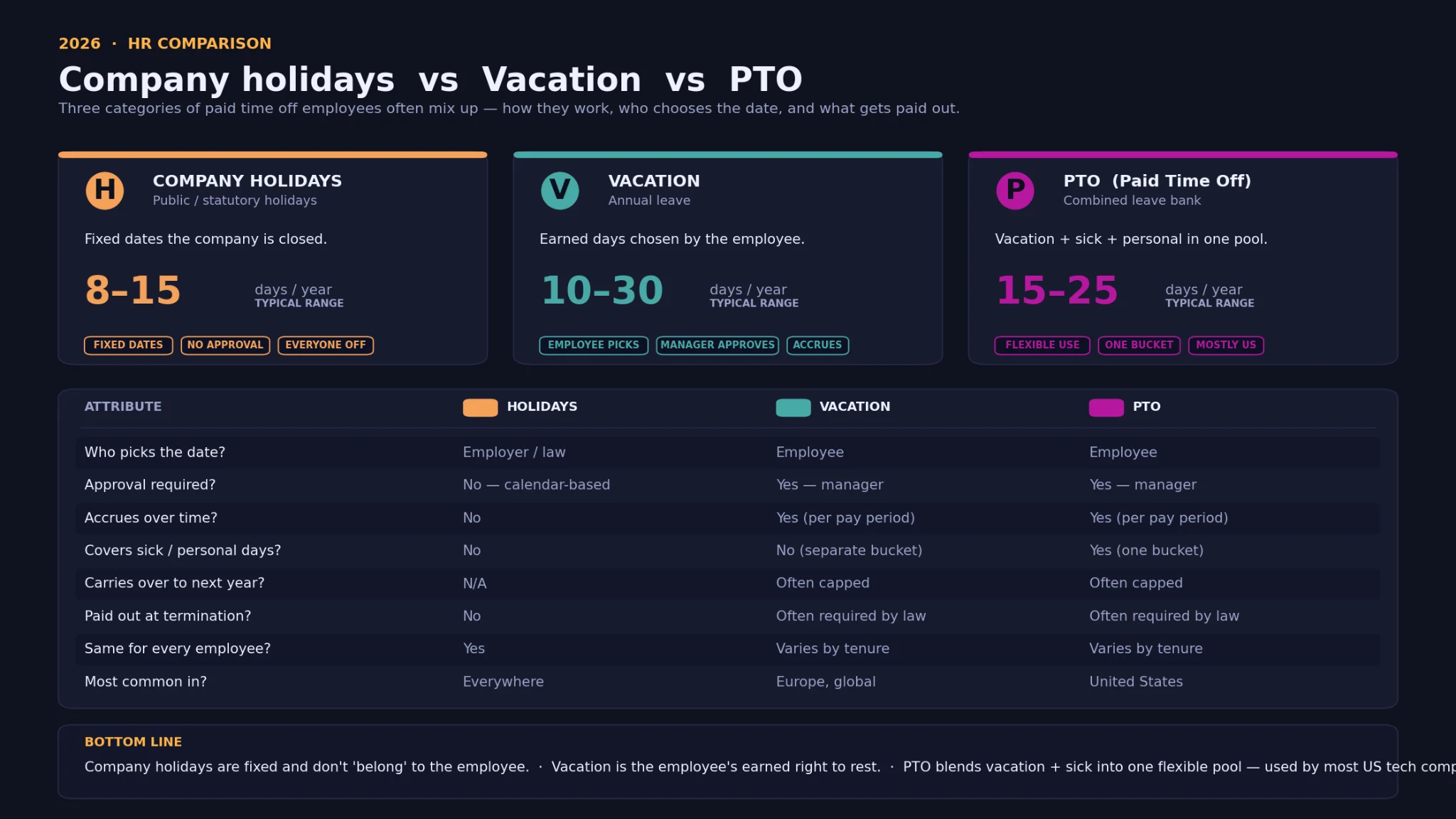
Pic.1. Comparison diagram — Company holidays vs. vacation vs. PTO.
Why clear holiday policies matter
- Legal compliance. Many countries mandate paid public holidays (France: 11, Japan: 16). US private employers are not federally required to provide paid holidays, but most do.
- Fairness and transparency. Employees know in advance which days they can reliably count as non-working.
- Operational planning. Predefined schedules let teams plan workflows, deadlines, and coverage.
- Culture and retention. Recognising cultural and religious observances signals respect for employee diversity.
What Paid Holidays Include and How Holiday Pay Works
A paid holiday is a day off on which employees receive their normal compensation without being required to work. Holiday pay typically covers regular base wages for standard working hours and usually excludes overtime premiums and performance bonuses.
Types of paid holidays in the US
- Federal holidays. 11 days recognised by the US government (New Year’s Day, MLK Day, Presidents’ Day, Memorial Day, Juneteenth, Independence Day, Labor Day, Columbus Day, Veterans Day, Thanksgiving, Christmas).
- State holidays. State-specific days such as Patriots’ Day (MA, ME) or Cesar Chavez Day (CA).
- Corporate or internal holidays. Company-set days like founding anniversaries, end-of-year shutdowns, floating holidays, or mental-health days.
Holiday pay at a glance
| Type of holiday | Who typically gets paid | Pay rate when worked |
|---|---|---|
| Federal / public holiday (private employer) | Most full-time staff (not legally required in US) | 1.0x base; many pay 1.5x if working |
| State holiday | Public-sector workers; some private employers | 1.0x base; 1.5x common if working |
| Corporate / internal holiday | All eligible employees per company policy | 1.0x base; 1.5x–2x if working |
| Floating holiday | Employees who schedule it in advance | 1.0x base (cannot be worked) |
| Religious accommodation | Employee using floating or vacation time | Regular rate |
US average: 8 paid holidays per year for private-sector workers (Bureau of Labor Statistics). Public-sector employees typically receive 10–11.
Company Holidays Calendar by Country [2026]
Holiday observances vary widely across regions. The table below summarises the standard schedule by country for 2026; expanded country-by-country lists follow.
| Country | Standard paid holidays | Notable observances (2026) |
|---|---|---|
| USA | 7–11 | New Year’s Day (Jan 1), Independence Day (Jul 4), Thanksgiving (Nov 26), Christmas (Dec 25) |
| Germany | 9–13 | New Year’s Day (Jan 1), Labor Day (May 1), German Unity Day (Oct 3), Christmas (Dec 25–26) |
| France | 11 | New Year’s Day, Labor Day (May 1), Bastille Day (Jul 14), All Saints’ Day (Nov 1) |
| UK | 8 | New Year’s Day, Good Friday (Apr 3), Early May Bank Holiday (May 4), Christmas (Dec 25–28) |
| Spain | 14 | New Year’s Day, Epiphany (Jan 6), Labor Day (May 1), Constitution Day (Dec 6) |
| China | 13 | Spring Festival (Feb 17, 2026), Labor Day (May 1–3), National Day (Oct 1–7) |
| Japan | 16 | New Year’s Day, Golden Week (Apr 29 – May 5), Sports Day (Oct 12, 2026), Emperor’s Birthday (Feb 23) |
| South Korea | 11 | Seollal (Feb 16–18, 2026), Independence Movement Day (Mar 1), Chuseok (Sep 25–27, 2026) |
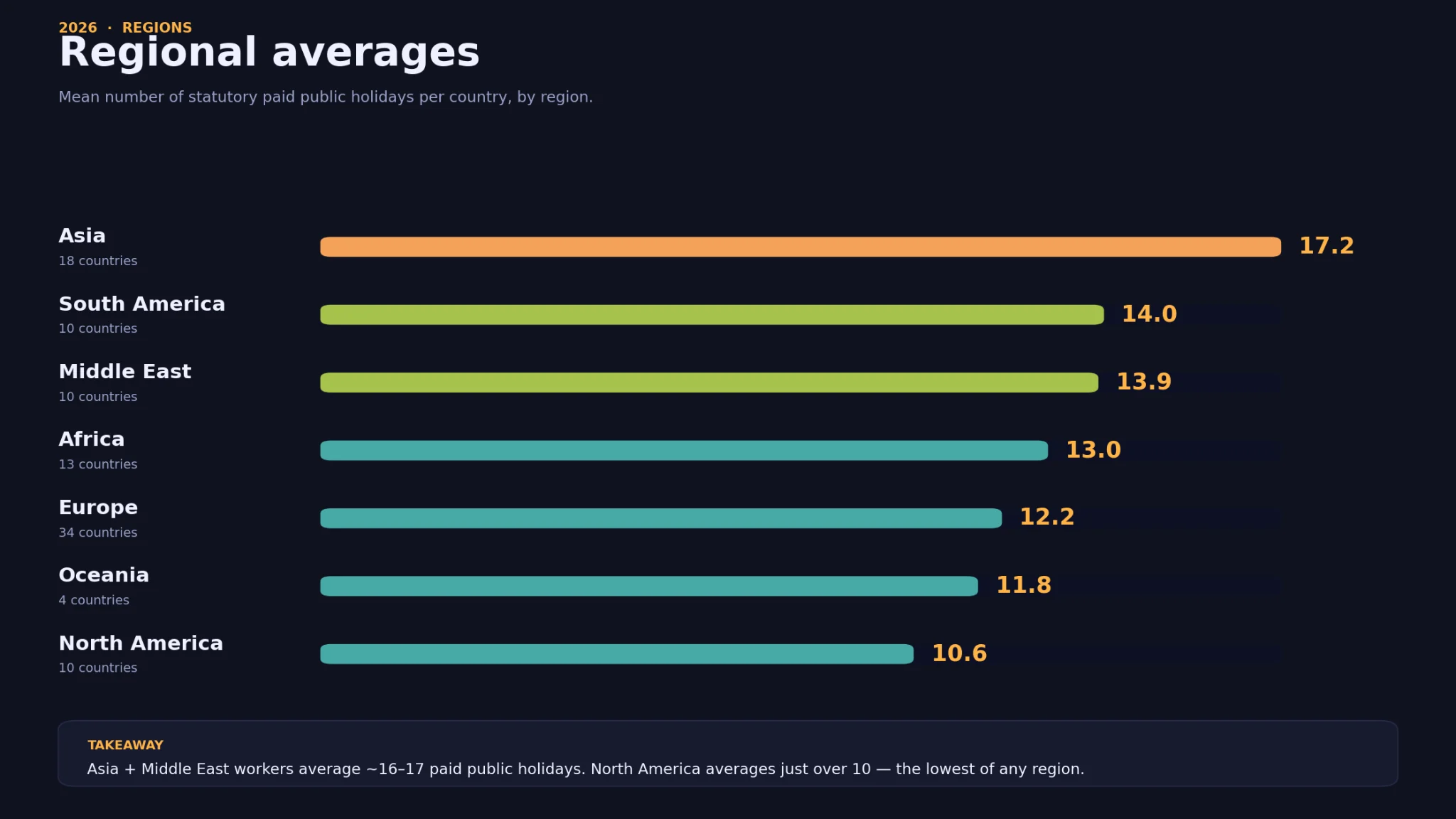
Pic.2. Average number of paid public holidays per region.
USA — 2026
- New Year’s Day — January 1
- Martin Luther King Jr. Day — January 19
- Presidents’ Day — February 16
- Memorial Day — May 25
- Juneteenth — June 19
- Independence Day — July 4
- Labor Day — September 7
- Columbus / Indigenous Peoples’ Day — October 12
- Veterans Day — November 11
- Thanksgiving Day — November 26
- Christmas Day — December 25
European Union — 2026
The EU has no unified holiday regulation; each member state maintains its own schedule. The Working Time Directive guarantees a minimum of four weeks of annual leave.
Germany (9–13 days, varies by state)
- New Year’s Day — January 1
- Good Friday — April 3, 2026
- Easter Monday — April 6, 2026
- Labor Day — May 1
- Ascension Day — May 14, 2026
- German Unity Day — October 3
- Christmas Day / Boxing Day — December 25–26
France (~11 days)
- New Year’s Day — January 1
- Easter Monday — April 6, 2026
- Labor Day — May 1
- Victory in Europe Day — May 8
- Bastille Day — July 14
- Assumption Day — August 15
- All Saints’ Day — November 1
- Armistice Day — November 11
- Christmas Day — December 25
Spain (14 days)
- New Year’s Day — January 1
- Epiphany — January 6
- Good Friday — April 3, 2026
- Labor Day — May 1
- Assumption Day — August 15
- National Day — October 12
- Constitution Day — December 6
- Christmas Day — December 25
United Kingdom — 2026
- New Year’s Day — January 1
- Good Friday — April 3, 2026
- Easter Monday — April 6, 2026
- Early May Bank Holiday — May 4, 2026
- Spring Bank Holiday — May 25, 2026
- Summer Bank Holiday — August 31, 2026
- Christmas Day — December 25
- Boxing Day — December 28, 2026 (observed)
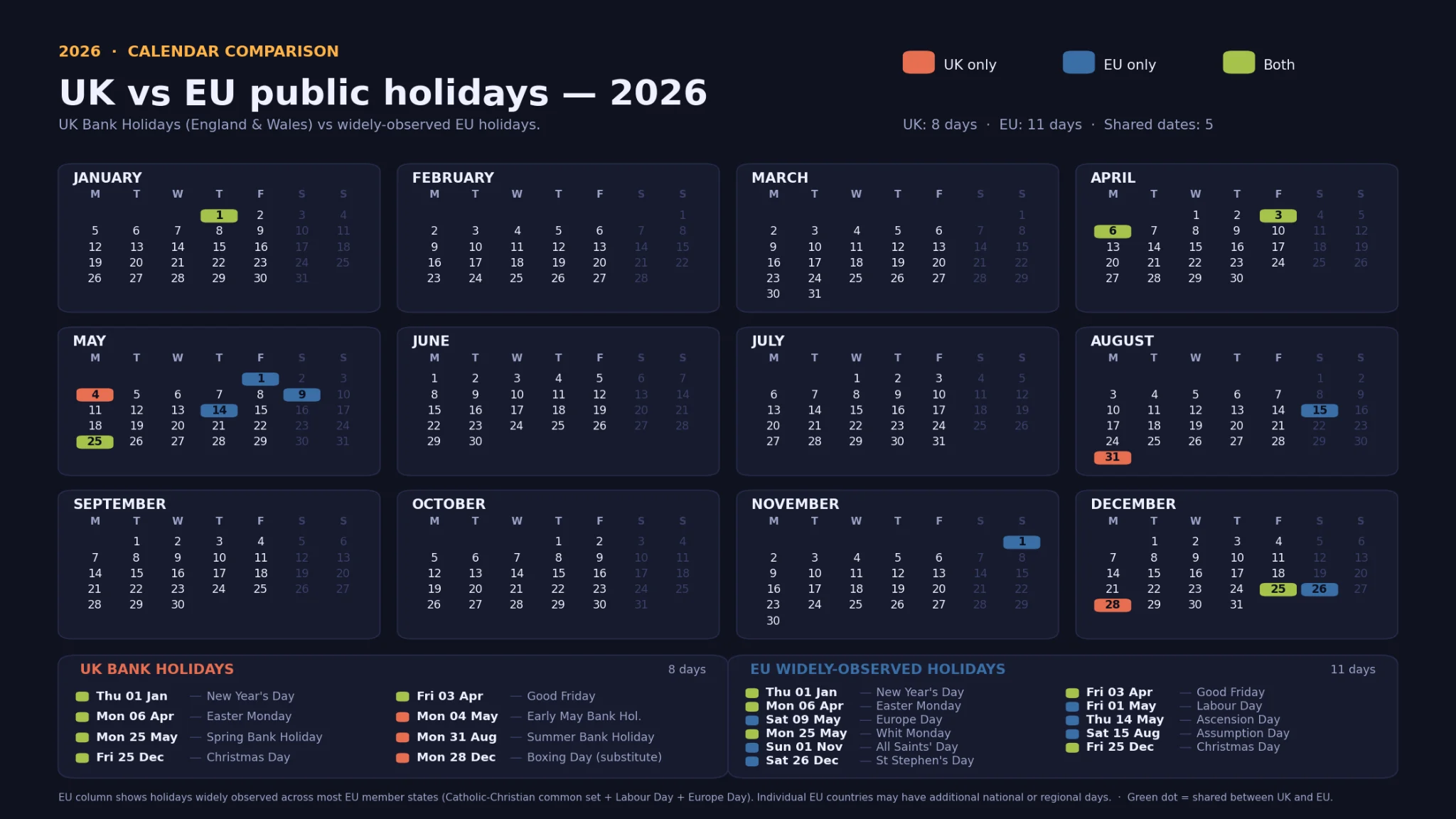
Pic. 3. Calendar view showing UK and EU 2026 holidays side by side.
Asia — 2026
China (13 days)
- New Year’s Day — January 1
- Spring Festival — February 17–23, 2026
- Qingming Festival — April 5, 2026
- Labor Day — May 1–3
- Dragon Boat Festival — June 19, 2026
- Mid-Autumn Festival — September 25, 2026
- National Day — October 1–7
Japan (16 days)
- New Year’s Day — January 1
- Coming of Age Day — January 12, 2026
- National Foundation Day — February 11
- Emperor’s Birthday — February 23
- Vernal Equinox Day — March 20, 2026
- Golden Week (Showa Day → Children’s Day) — April 29 – May 5
- Marine Day — July 20, 2026
- Mountain Day — August 11
- Respect for the Aged Day — September 21, 2026
- Sports Day — October 12, 2026
- Culture Day — November 3
- Labor Thanksgiving Day — November 23
South Korea (11 days)
- New Year’s Day — January 1
- Seollal (Lunar New Year) — February 16–18, 2026
- Independence Movement Day — March 1
- Buddha’s Birthday — May 24, 2026
- Children’s Day — May 5
- Memorial Day — June 6
- Liberation Day — August 15
- Chuseok — September 25–27, 2026
- National Foundation Day — October 3
- Hangul Day — October 9
Organizing Company Holidays for International Teams
Multinational organisations must accommodate different holiday schedules across every country in which they operate. A “one-size-fits-all” calendar breaks down quickly; instead, teams need flexible frameworks that respect local observances while preserving global cohesion.
Best practices
- Centralise the calendar. One shared, company-wide calendar that overlays every regional holiday, syncs with Outlook and Teams, and visually distinguishes global vs. local days.
- Enable regional filtering. Let each employee prioritise their home country while keeping a single click to “show all regions” when planning international work.
- Bake holidays into project planning. Build buffer time around major holiday clusters (December in the West, Lunar New Year in Asia).
- Document the policy. Cover overlapping days, religious accommodations, equity across regions, and short-term international assignments.
- Audit annually. Refresh dates and verify legislative changes every November for the following year.
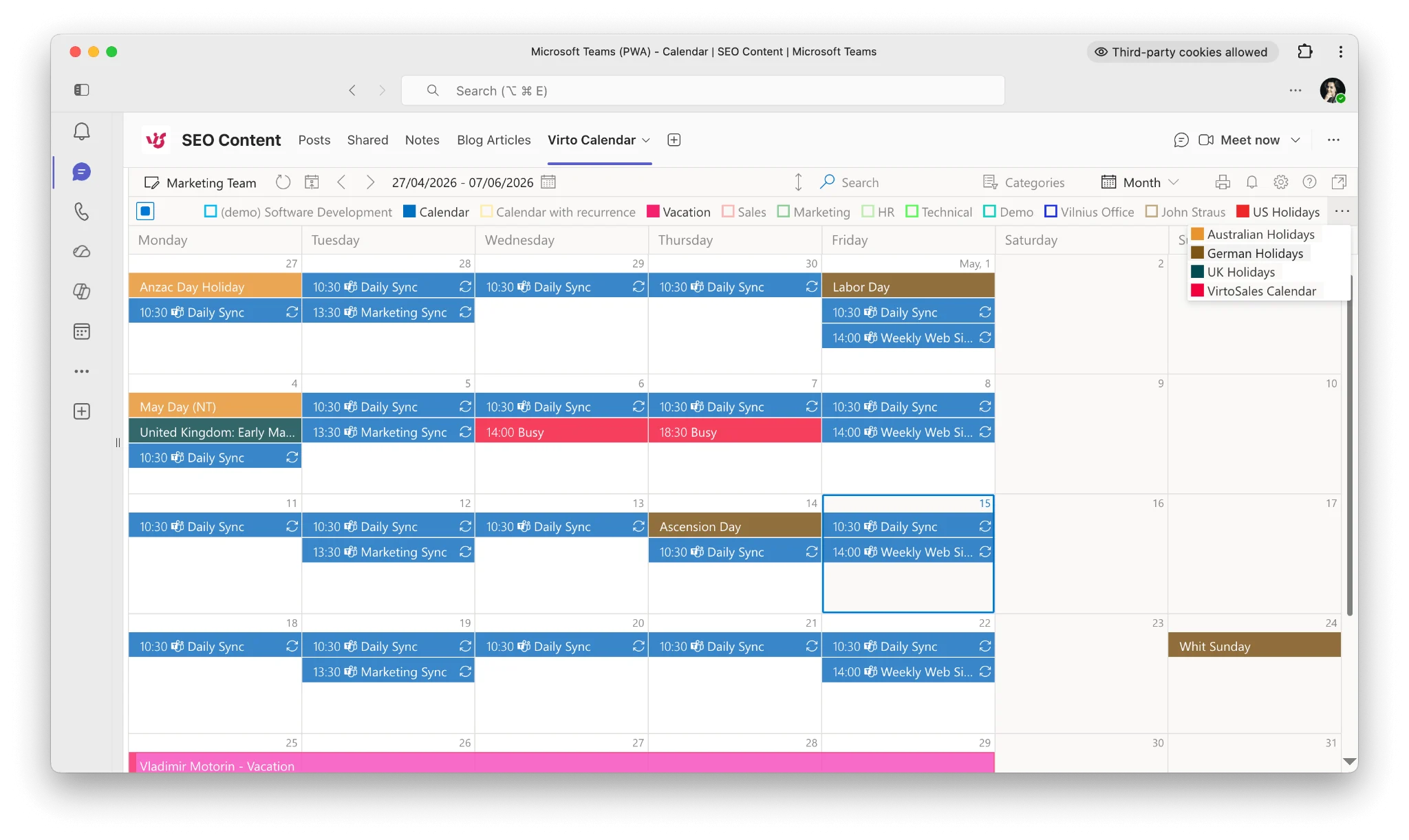
Pic. 4. Global team calendar with regional holidays colour-coded.
See how Virto Calendar App solves this:
One calendar that overlays every regional holiday on top of your existing Outlook and Teams setup — without changing how your team already works.
The Challenge of Tracking Holidays Across Multiple Systems
Managing holiday schedules manually in Outlook becomes unwieldy fast. When your team spans multiple countries — each with different public holidays — the problem compounds: overlapping calendars, missed notifications, scheduling conflicts with colleagues in other time zones, and HR data scattered across multiple tools.
- No single view of who’s off across the whole company. HR and managers must check individual Outlook calendars one by one to assess team availability.
- Holiday data lives in disconnected sources. Some holidays sit in Outlook, others in SharePoint lists, Planner tasks, or external HR systems — with no overlay.
- No automatic conflict alerts. Outlook does not warn you when you schedule a meeting that conflicts with a colleague’s regional holiday in Germany or Japan.
- Updating global holiday calendars is manual. Shared Outlook calendars require someone to manually add every regional public holiday — and keep them updated year to year.
Virto Calendar App solves all four of these problems natively inside Microsoft 365 — without requiring any changes to your existing Outlook setup.
See how it works → virtosoftware.com/microsoft-365/virto-calendar-overlay-app/
How to Create a Company Holiday Policy
A documented holiday policy prevents misunderstandings, ensures legal compliance, and keeps workforce planning predictable. The most useful policies do not try to enumerate every edge case — they cover eight essential components and rely on a centralised calendar for the dates themselves.
8-point company holiday policy checklist
- Recognised holidays. Full list of company-wide and regional holidays, with formulas for floating dates (e.g., “3rd Monday in January”).
- Eligibility. Which employee categories (full-time, part-time, temporary, contract, new hires) qualify for holiday pay.
- Compensation structure. Base pay for the day off, premium rate for holiday work (commonly 1.5x–2x), and rules for comp time.
- Floating holidays. Annual allocation (typically 1–3 days), scheduling rules, expiration, and probationary period.
- Request and approval workflow. Notice periods, submission channel, approval authority, and how competing requests are handled.
- Operational coverage. How essential operations stay staffed: rotation schedules, volunteer windows, and inverse-seniority assignment.
- International and remote rules. Which schedule applies to remote workers and employees on short- or long-term international assignments.
- Calendar access and updates. Where the official calendar lives, who maintains it, and how mid-year changes are communicated.
How Virto Calendar App Helps Manage Company Holidays
You’ve established your company holiday policy. The next question is operational: how do you make those holidays visible to everyone, automatically, across every Microsoft 365 tool your team already uses?
Virto Calendar App for Microsoft 365 lets you combine regional holiday calendars, SharePoint lists, Exchange calendars, and team schedules into a single view — without forcing anyone to leave Outlook or Teams.
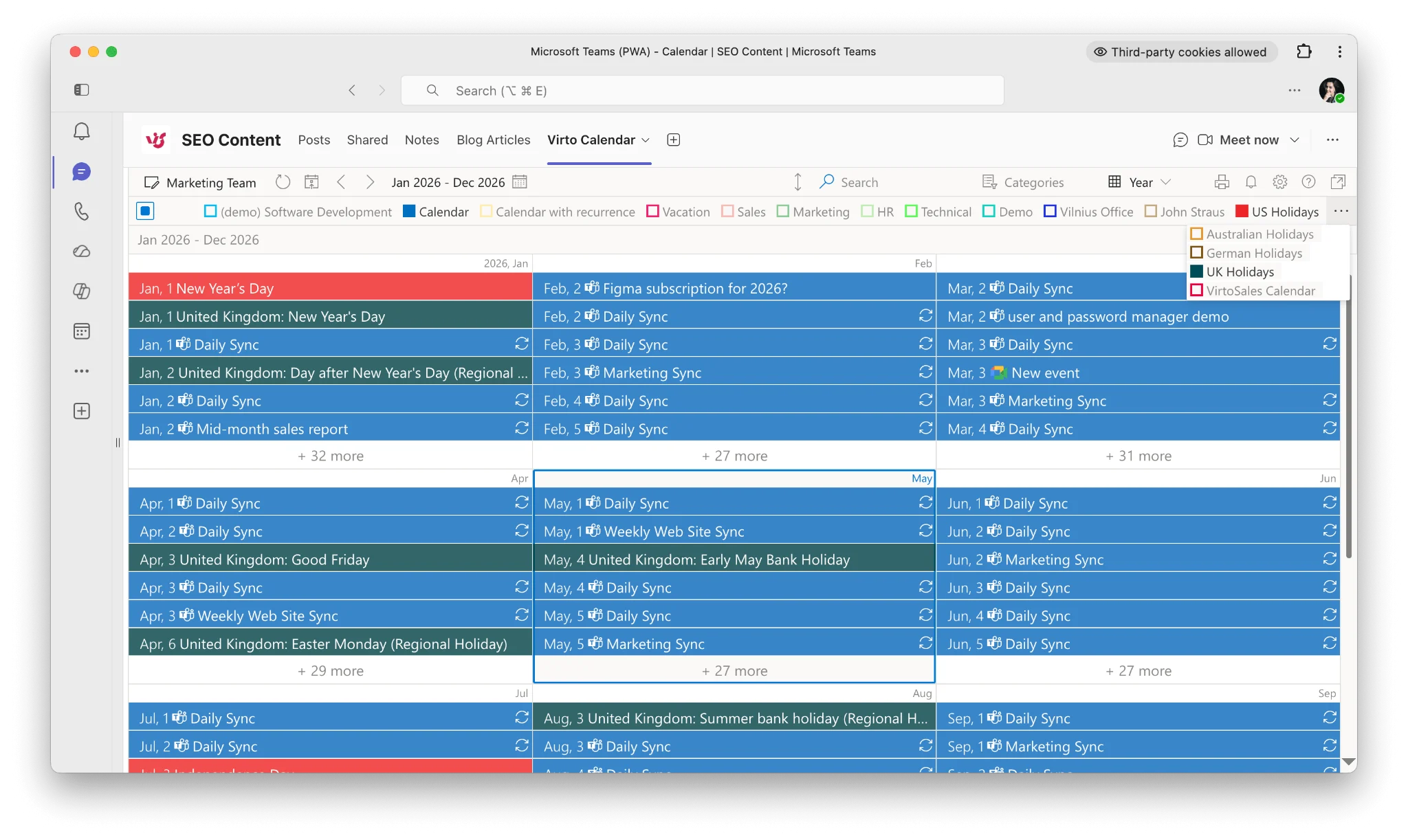
Pic. 5. Virto Calendar App showing multiple regional holiday sources in one view.
Holiday-specific capabilities
- Multi-source overlay. Combine regional holiday calendars (iCal, SharePoint lists, Exchange) into one view alongside team schedules.
- Colour-coding by region. Instantly distinguish US, UK, EU, and Asia holidays in a single calendar view.
- Conflict alerts. With Virto Alerts & Reminders App, get automatic notifications when scheduling crosses a colleague’s regional holiday.
- Flat Year View. Plan resource coverage for the full year with holiday blocks visible at a glance.
- Self-hosted Azure deployment. HR holiday data stays inside your organisation’s infrastructure.
- Free for a month. Try it with your core HR or ops team first, then scale.
Manual Outlook vs. Virto Calendar App
| Capability | Manual Outlook approach | Virto Calendar App |
|---|---|---|
| View all team holidays in one place | Open each person’s calendar separately | All calendars overlaid in one view |
| Regional holiday calendars | Manual entry per country | Import via iCal or SharePoint list |
| Conflict alerts for holiday overlaps | Not available | Automatic (with Virto Alerts App) |
| Year-at-a-glance planning view | Not available | Flat Year View |
| Colour-coding by country / region | Categories only | Per-source colour coding |
| Data stays in your infrastructure | Yes (M365) | Self-hosted in your Azure subscription |
| Free tier | Included with M365 | Free for a month |
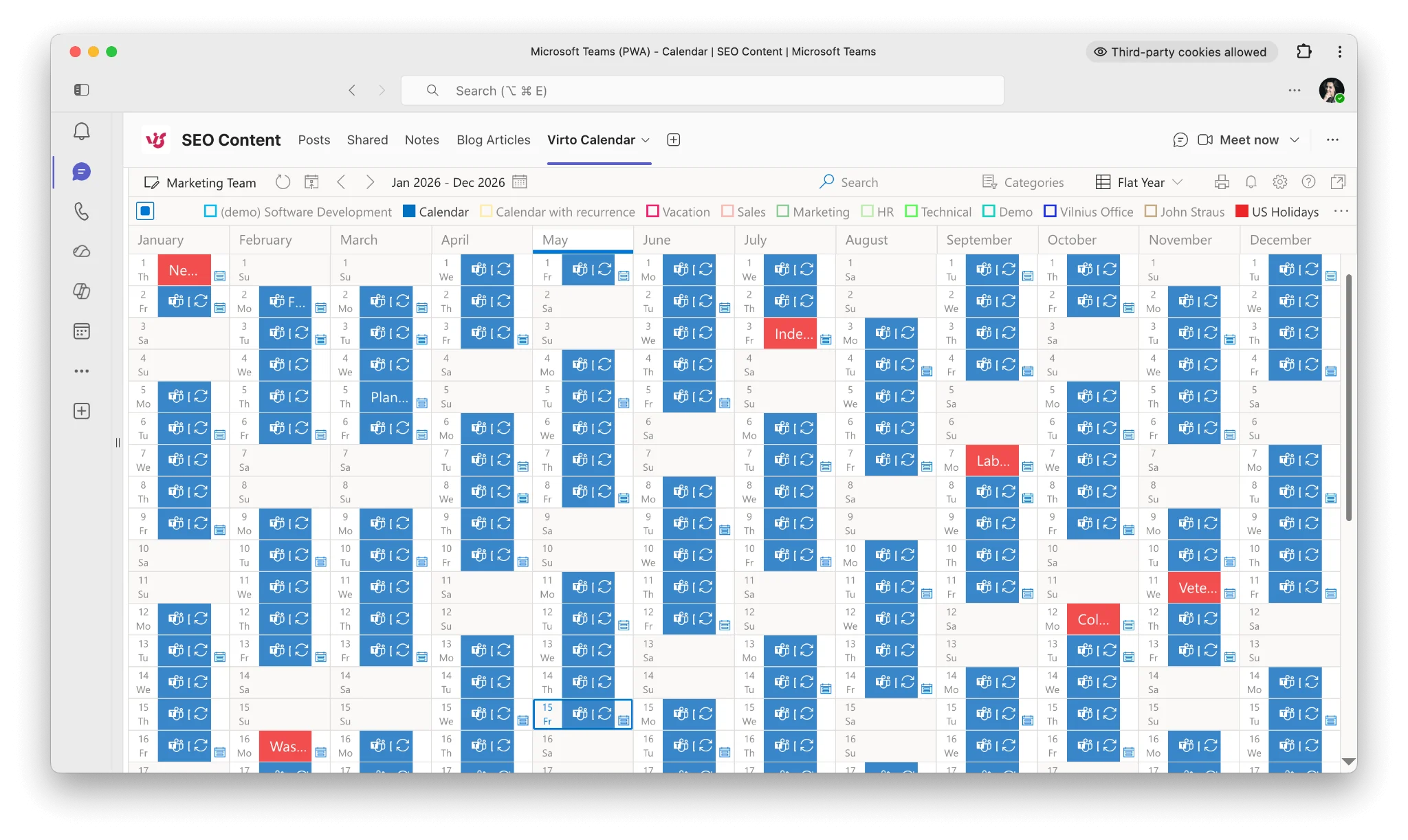
Pic. 6. Flat Year View with overlaid global holidays.
Next steps
- See Virto Calendar App for M365 →
- Free trial: Start free trial for a month (Microsoft Marketplace)
- Talk to us: Book a 30-minute demo with our team
Frequently Asked Questions
1. What are typical paid holidays in the US?
Most US companies observe 7–11 paid holidays: New Year’s Day, MLK Day, Presidents’ Day, Memorial Day, Juneteenth, Independence Day, Labor Day, Thanksgiving, and Christmas. Many add Veterans Day, Columbus Day, Christmas Eve, or a floating holiday. Private employers are not legally required to provide paid holidays under federal law, but most do as a standard benefit.
2. How many paid holidays do most companies give?
The US average is 8 paid holidays per year for private-sector workers (Bureau of Labor Statistics). Government employees typically receive 10–11. European companies often observe 10–14 and Asian companies 11–16, depending on the country.
3. What is a corporate holiday?
A corporate holiday is an officially designated non-working day established either by law (public or federal holidays) or by the company itself (internal company holidays). During corporate holidays, employees typically receive their regular pay without being required to work.
4. What holidays do people get off work?
In the US, the most commonly observed days off are Christmas Day, Thanksgiving, Independence Day, Labor Day, Memorial Day, and New Year’s Day. Most full-time employees at private companies receive these six core holidays as paid time off.
5. What is included in holiday pay?
Holiday pay typically includes an employee’s regular base wages for their standard working hours. It usually excludes overtime premiums and performance bonuses. If an employee works on a holiday, they commonly receive 1.5x (time-and-a-half) or 2x their regular pay, depending on company policy and applicable labour laws.
6. How do I manage company holidays across international teams?
Create a centralized global holiday calendar that all team members can access, use colour-coding to distinguish holidays by region, and build buffer time into project timelines around major holiday clusters (December in Western countries, Lunar New Year in Asia). Tools like Virto Calendar App integrate regional holiday calendars directly into Microsoft 365, with automatic conflict alerts when meetings overlap with colleagues’ local holidays.
Conclusion
A well-designed holiday policy is a strategic investment in culture, planning, and employee well-being — not just a list of dates. Pair a clear policy with one centralised, overlaid calendar and most of the operational friction disappears: managers see who’s off, schedulers avoid regional clashes, and HR stops chasing dates every November.
For international and distributed teams, the Virto Calendar App is the simplest way to keep every regional holiday visible inside the Microsoft 365 tools your people already use.
Get started with Virto Calendar App
- Primary: See Virto Calendar App for M365 →
- Free trial: Start free trial for a month (Microsoft Marketplace)
- Talk to us: Book a 30-minute demo with our team